
ASVA Conference bookings are now open! Join us on 12th November in Perth. Find out more details and book your tickets here.
News
How risky play helps children thrive
Added: 04 May 2026
Thanks to Timberplay for providing this insightful article exploring the importance of risky play in children’s development. Drawing on their expertise in designing engaging, challenging play environments, Timberplay highlight how carefully considered opportunities for risk can help children build confidence, resilience and essential life skills.
We want the children in our lives to be confident, resilient, self-aware people who can manage life, with ease.
At Timberplay, we design playgrounds that create opportunities for children to experience risk and challenge while buidling confidence in managing it safely. Exposure to risky play from an early age supports children to grow into more confident, resilient individuals.
Risky play is understood to improve mental and physical health, prevent obesity, mitigate anxiety, improve balance and spatial awareness.
Adults naturally want to protect children, but this instinct must be balanced with an understanding of how valuable it is for children to make mistakes, slip up and even fail. A well designed playspace should offer far more than a single whizz down a slide, or a simple up and down to get up higher. It should have a range of open ended opportunities to enable problem solving, challenge, risk and collaboration. Through these experiences, children learn how to protect themselves, even if there are a few bruises along the way.
While we can’t predict the world children will grow up to navigate, we can support their development from birth through to adulthood. By offering opportunities that build resilience and adaptability, play helps children develop the independent skills they will need to thrive in an uncertain future.
Play is essential to development.
Risk is an essential part of play.
As an organisation we actively advocate for children’s right to take risks because research and experience show that risky play supports both mental and physical health. It helps prevent obesity, reduce anxiety, improve balance and increase spatial awareness.
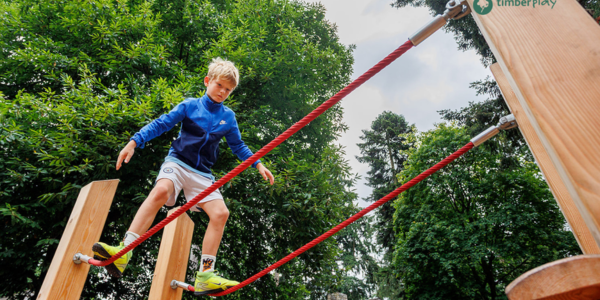
You can see this drive for challenge in children every day. Not only when they climb higher or run faster, but in the small moments too, when stepping only on kerbstones, walking backwards, turning the familiar into something more demanding. Children instinctively seek to make the mundane more challenging, more risky and ultimately, more fun!
Without the time, space and support to engage in this type of play, other risks emerge. That’s why, when creating playgrounds in a wide range of settings, we work closely with clients to consider the value of the play being offered. Not to tick a box on a masterplan or enhance a brochure, but to create playspaces that genuinely enrich children’s lives and become places families want to return to, again and again.
To find out more about Timberplay you can visit our website here: www.timberplay.com or email us info@timberplay.com with any enquiries. Do follow us on social media where we regularly share our podcast Play Attention which hosts conversations with
Thinkers and changemakers, shaping the future of play.